
The 90/10 rule, and what actually gets you banned on Reddit
Everyone quotes Reddit's 90/10 self-promotion rule. Reddit quietly retired it. Here's what really triggers a ban, and the groundwork that lets founders post without one.
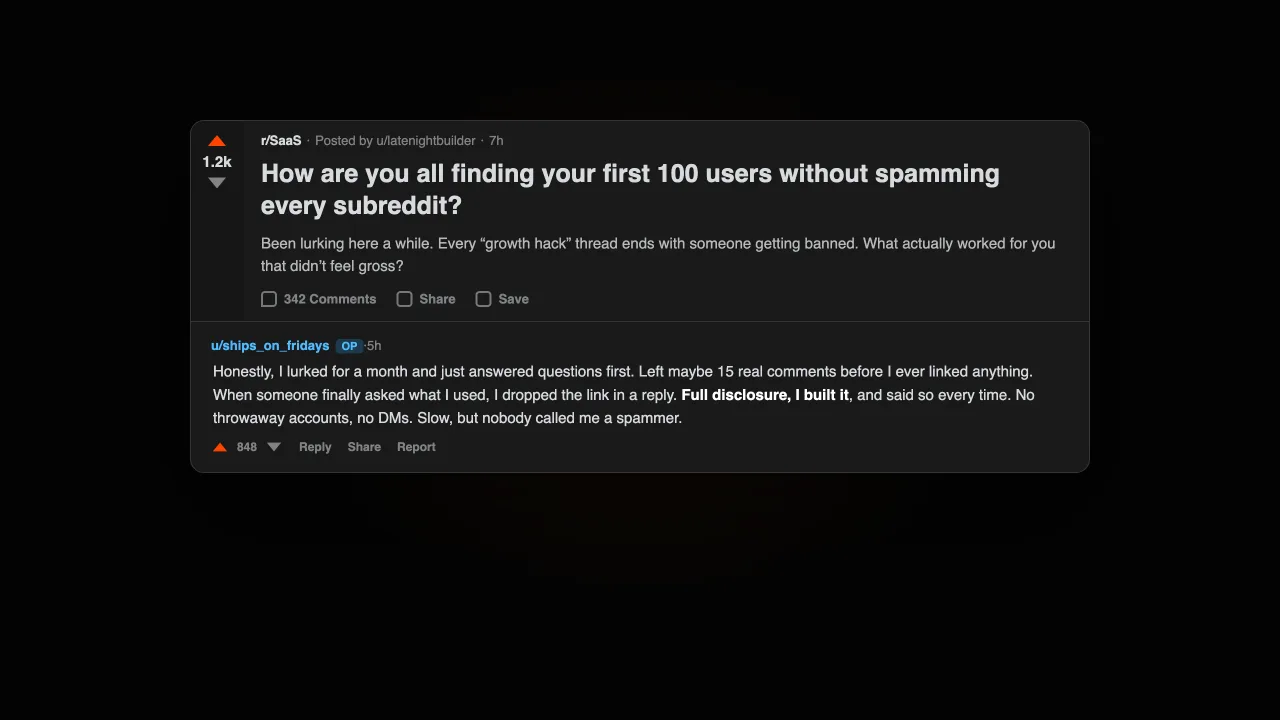
If you’ve spent an afternoon reading about how to promote on Reddit, you’ve met the 90/10 rule. Ninety percent of what you do should be genuine participation, ten percent can mention your own thing. It gets quoted in every guide like scripture.
Here’s the part those guides skip: Reddit retired it. The formal “10% rule” was pulled back in 2016, the old self-promotion page they all used to link to is gone from the help center, and the ratio isn’t in the site-wide rules anymore. So most of the internet is citing a rule that officially doesn’t exist.
That sounds like good news if you were hoping to skip the work. It isn’t. The rule went away because it was too rigid, not because Reddit stopped caring. What replaced it is fuzzier and, honestly, harder to game. Reddit’s own guidance put it better than a number ever did: it’s fine to be a Redditor with a website, it’s not fine to be a website with a Reddit account. The ratio was only ever a clumsy proxy for that. Now you’re graded on the actual thing, and a good chunk of moderators still keep a rough ratio in their head while they do it.
What the rule was really about
Nobody at Reddit was counting to ten. The 90/10 framing existed to describe a pattern moderators and other users can smell in about four seconds: an account that only exists to promote.
Go look at the profile of anyone who got called out for spamming a subreddit. The tell is never a single link. It’s that every post and comment they’ve ever made points back at the same product. No questions answered, no jokes, no arguing about something pointless, just a person-shaped billboard. That’s what gets removed. The ratio is just the math that describes it.
So the useful version of the rule isn’t a number. It’s a question you can ask about your own account: if a moderator opened my history right now, would they see a member or a marketer? If the honest answer is marketer, no clever ratio saves you.
The fastest ways to get yourself banned
Before the part where I tell you what works, here’s what reliably ends badly. These aren’t guesses. They’re the patterns Reddit’s spam filter is tuned to catch, and it catches them fast.
- The five-subreddit blast. Dropping your link in five subreddits in one afternoon, from an account with no comment history in any of them, is the single most reliable way to earn a sitewide shadowban. The filter flags it within minutes, and shadowbans are close to impossible to appeal because you often don’t even know you have one. Your posts just quietly go nowhere.
- Shortened or affiliate links. A bit.ly or a tagged affiliate URL reads as spam to both the filter and to people. Post the real link or no link.
- Padding your ratio with garbage. People realize they’ve been too promotional, then try to fix it by leaving twenty low-effort “great post!” comments to rebalance the numbers. Moderators spot pattern-comments instantly, and now you look like someone gaming a ratio, which is worse than looking promotional.
- The brand-new account. An account created last week, with 3 karma, posting a product link, is the exact fingerprint the anti-spam model was built to stop. Age and history are trust, and you can’t fake either in a hurry.
None of these are about Reddit hating promotion. Reddit doesn’t hate promotion. It hates low effort and rule-breaking, which is a different and much more forgiving thing.
What actually works
The founders who pull this off well all do a version of the same unglamorous groundwork.
They show up before they need anything. Two or three weeks before there’s any link to share, they leave ten or fifteen genuinely helpful comments in the subreddit they care about. Real answers to real questions, the kind that take a few paragraphs and some actual knowledge. By the time they post their own thing, the regulars have seen the username before. That familiarity is what does the work.
They put the link in the comments, not the post. This one is worth internalizing. Some of the best-performing founder posts don’t contain a link at all in the body. They tell a story, share a result, ask a question. Then, when someone inevitably replies “where can I try this?”, the founder drops the link in a comment. That’s the cleanest possible signal that you came to talk, not to advertise, and the algorithm and the humans both reward it.
They say they built it. “Full disclosure, I made this” earns more trust than any amount of careful phrasing meant to hide it. People on Reddit are fine with founders. They are not fine with being deceived by one. Disclose every time.
They message the mods first. A short, polite modmail before posting (“I’d like to share the tool I built, does that fit your rules, and is there a right thread for it?”) does two things. It keeps you from a permanent ban over a rule you didn’t see, and it occasionally gets you an actual invitation to post, which is the strongest position you can be in.
Where promotion is genuinely welcome
Not every subreddit wants you to tiptoe. Some have carved out space for exactly this, and knowing which is which saves you a lot of grief. As always, read the current sidebar before you trust any list, because mods change rules and this stuff drifts.
| Subreddit | What it tolerates |
|---|---|
| r/SaaS | Friendly to founders if you frame it as a progress update, a pricing experiment, or a feedback request. Not as an ad. |
| r/startups | Strict. Self-promotion lives only in the weekly feedback thread. Post there, nowhere else. |
| r/Entrepreneur | Lighter moderation, but obvious promotion still gets downvoted into the ground. Lead with a lesson, not a link. |
| r/roastmystartup | You’re inviting criticism, which is the point. Great for honest early feedback. |
| r/SaaS_Promotions | Direct promotion is the format. Most posts are required to include pricing. |
| r/shamelessplug | Nearly anything goes with the right tag. Good for testing a pitch, low on qualified traffic. |
The pattern across all of them: the communities that welcome promotion still punish laziness. A thoughtful post in a promo-friendly subreddit does well. A copy-pasted one dies there too.
Finding the threads worth being helpful in
Here’s the quiet cost of doing this right. Being a real member of a community takes time, and you only have so much of it to spend. Which means the subreddits you invest in have to be the ones where your actual customers hang out, not just the biggest ones.
That’s the part I work on, so take this with the appropriate salt. The desktop app I build reads Reddit (and YouTube) the way you would, finds the threads where people are already describing the problem you solve, and scores them so you know which conversations are worth your two weeks of showing up. It drafts a reply too, but you send it yourself, from your own account, after you’ve made it sound like you. No throwaway accounts, no auto-posting, none of the stuff in the “how to get banned” section above. If that’s useful, it’s here.
You don’t need a tool to do any of this, though. You need a real account, some patience, and the willingness to be helpful before you ask for anything. That was the actual rule the whole time. The 90/10 number was just how people tried to describe it.
For more on why the reading part is harder than it looks, and why so many Reddit tools keep breaking, see what happened to GummySearch.
Want to try it on your own market?
Leadiver finds warm leads on Reddit and YouTube, scores them against your customer, and drafts the first reply. It browses like a real person, not an API call.
Get early access