
YouTube comments are a goldmine almost nobody mines
Under the right video sits a room full of people mid-decision. A playbook for which videos to watch, what to look for in the comments, and how to show up without being the spammy brand.
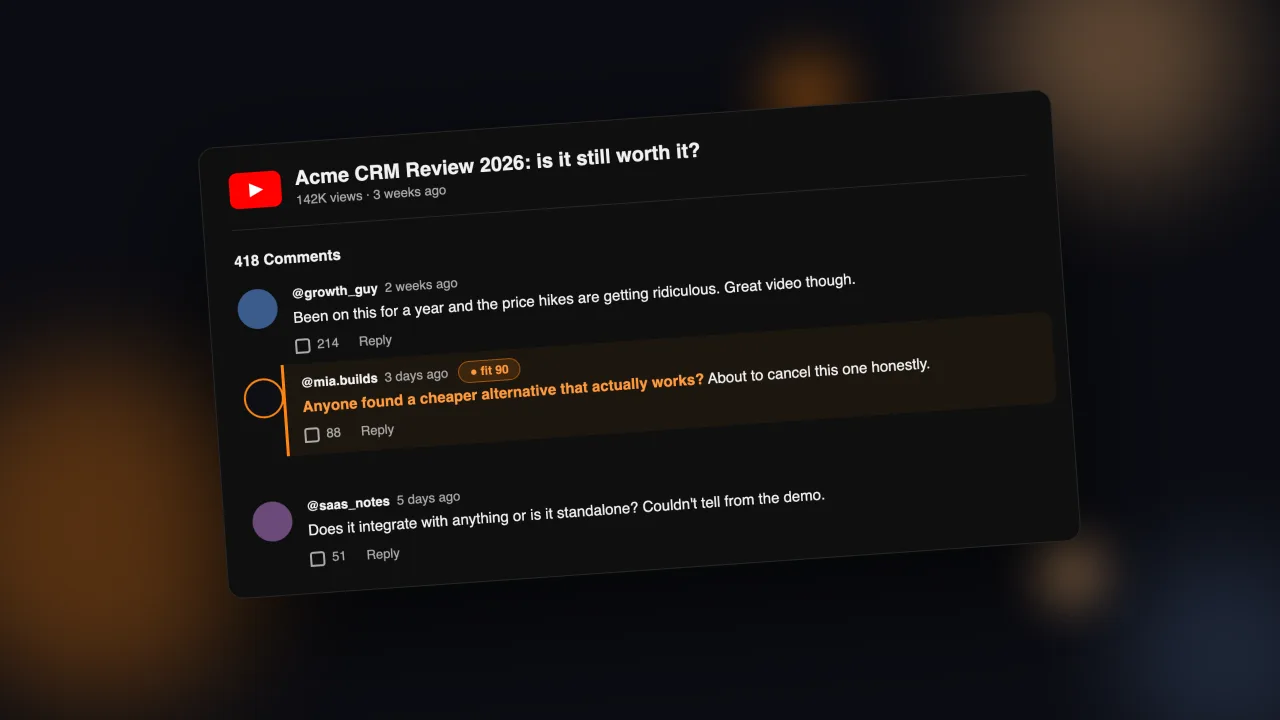
Everybody treats YouTube as a place to broadcast. You make a video, people watch it, the end. Meanwhile the comment section under someone else’s video is doing something far more interesting: it’s filling up with people who are actively deciding whether to buy something in your category, saying so out loud, and getting almost no reply from the companies that should care.
Reddit gets all the attention for this. YouTube comments are the half nobody works, and that’s exactly why they’re worth your time.
Why the comments, specifically
People comment on YouTube in a particular frame of mind. They’re not idly scrolling a feed. They came looking for a review, a tutorial, or a comparison, which means they’re evaluating, and the comment they leave is usually a real question or a real objection from that moment of evaluation.
And there are more of them than ever. One 2026 analysis clocked YouTube comments rising 38% in a year, growing nearly four times faster than likes. People aren’t just watching. They’re talking, under videos about the exact problem you solve, right at the point where they’re weighing options.
Which videos to sit under
Not every video is worth your time. The trick is that the type of video tells you what stage the commenter is at. Pick the ones where people are closest to a decision.
- “[Competitor] review” and “[X] vs [Y]” videos. The warmest room on the platform. Everyone in the comments is comparing options right now, and many are unhappy with what they’re comparing. A comparison video is a lineup of people telling you what the alternatives get wrong.
- “How to [do the thing your product does]” tutorials. These pull in people who have your problem and are currently solving it the slow, manual way. They don’t know an easier option exists yet. That’s the earliest and least contested place to be helpful.
- “Best [category] 2026” list videos. Pure shortlisting behavior. People in these comments are building their options list out loud, and asking each other “anyone actually used number three?”
- Results videos: “I tried [thing] for 30 days.” Outcome-seekers. They want proof it works before they commit, and the comments are full of “did it actually stick?” doubts you can speak to.
You don’t need a video of your own for any of this. You need to know which of other people’s videos your buyers are already gathered under.
What to look for once you’re there
The mechanics of actually searching a comment section (YouTube has no native search, so you load the comments and use Cmd+F, or a finder tool) I covered in the find-people-in-their-own-words playbook. Here’s what to search for.
Straightforward buying signals:
- “where can I buy / sign up / get this”
- “does it do [specific thing]”
- “is there a cheaper one”
- “still the best in 2026?”
- “anyone found an alternative to this”
Then the subtler one, which is the real edge: repeated confusion at the same timestamp. When you see five different people comment “wait, what happened at 4:30” or “how did you get it to do that,” you’ve found a gap. Something is hard, or unclear, or missing from the thing the video is about. If your product fixes that specific friction, those five people are your pitch, pre-written by them.
How to show up without becoming the spammy brand
YouTube has the same allergy to obvious shilling that Reddit does. A brand account dropping “check out our tool 👇” under a competitor’s video gets the same eye-roll and does the same damage.
So the rules rhyme with the Reddit ones. Answer the actual question the person asked. Be genuinely useful first. Say who you are if your product comes up. One thing YouTube makes easier: you mostly can’t slide into DMs, so almost everything is a public reply, which keeps you honest by default. If it would embarrass you to have the whole comment section see it, don’t post it.
There’s a second move here too, quieter and slower. The creator whose video this is has spent years assembling an audience of your exact buyers. Being a real, recurring, helpful presence in their comments, and eventually knowing the creator, is worth more than any single reply. Their audience is the room. You’re just trying to be a welcome regular in it.
Even the comments you never reply to are worth reading
Here’s the part that pays off regardless of whether you ever post. A competitor’s comment section is the cheapest customer research you will ever run. No survey, no incentive, no scheduling calls. Just hundreds of people describing, in their own words, what they want, what they’re confused by, and what would make them switch.
Keep a running note of the phrases that repeat. The objection you see fifteen times is the objection your landing page should answer. The feature people keep begging the competitor for is the feature to lead with, or the wedge to build. This is voice-of-customer data lying in the open, and most founders walk right past it.
The catch
The honest downside is scale. The signal is spread across dozens of videos and thousands of comments, and reading it all by hand is a full afternoon that you have to repeat as new videos go up.
That reading is what I build a tool for, so keep that in mind. The desktop app I work on reads YouTube comment sections as well as Reddit threads, scores which commenters actually fit who you sell to, and drafts a first reply for the ones worth it. You review and post it yourself. If the manual version sounds right but the scrolling doesn’t, that’s the pitch.
But the platform doesn’t require any of that. It just requires you to notice that while everyone else is fighting to be seen on YouTube, the people who want to buy are down in the comments, talking, and waiting for someone to actually answer.
Want to try it on your own market?
Leadiver finds warm leads on Reddit and YouTube, scores them against your customer, and drafts the first reply. It browses like a real person, not an API call.
Get early access